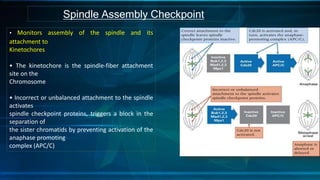
Spindle assembly checkpoint insensitivity allows meiosisII despite Biology Diagrams The spindle assembly checkpoint (SAC) is a pivotal regulatory mechanism during mitosis that ensures accurate chromosome segregation. Defects in the SAC can lead to severe consequences, including the development of cancer. Mutations or dysregulation of SAC components are implicated in various tumor types, underscoring the importance of this The transmission of a complete set of chromosomes to daughter cells during cell division is vital for development and tissue homeostasis. The spindle assembly checkpoint (SAC) ensures correct

Genome stability is essential for cell proliferation and survival. Consequently, genome integrity is monitored by two major checkpoints, the DNA damage response (DDR) and the spindle assembly checkpoint (SAC). The DDR monitors DNA lesions in G1, S, and G2 stages of the cell cycle and the SAC ensures proper chromosome segregation in M phase.

Evidence That a Defective Spindle Assembly Checkpoint Is Not the ... Biology Diagrams
The spindle checkpoint, also known as the metaphase-to-anaphase transition, the spindle assembly checkpoint (SAC), the metaphase checkpoint, or the mitotic checkpoint, is a cell cycle checkpoint during metaphase of mitosis or meiosis that prevents the separation of the duplicated chromosomes until each chromosome is properly attached to the Author Summary Checkpoints are surveillance pathways that monitor and correct cellular errors to ensure that the genome is transmitted intact through cell division; defects in checkpoints lead to human disease such as cancer. Two major checkpoint pathways that have been extensively studied are the DNA damage response and the spindle assembly checkpoint. As their names imply, they have been
A second well‐established idiosyncrasy of mammalian oocytes that likely contributes to aneuploidy is that the spindle assembly checkpoint (SAC), which prevents anaphase until all chromosomes achieve proper biorientation and alignment in most cells (Musacchio & Salmon, 2007; Lara‐Gonzalez et al, 2012; Musacchio, 2015) is weak in oocytes.This has been extensively established in oocyte M‐I Note that while the term 'spindle assembly checkpoint' is firmly entrenched, it is a misnomer; Spindly-box', dynein is still not recruited but the persistence of Spindly at kinetochores now results in a stripping defect . Therefore, dynein-mediated removal of Spindly from attached kinetochores is the critical step for the stripping of
![[PDF] The Spindle Assembly Checkpoint and Aneuploidy Biology Diagrams](https://i1.rgstatic.net/publication/279187893_The_Spindle_Assembly_Checkpoint_and_Aneuploidy/links/558f27d608ae1e1f9bace737/largepreview.png)
The spindle assembly checkpoint: Preventing chromosome mis Biology Diagrams
Real-time imaging of oocytes maturing in vitro demonstrates evidence that a defective spindle assembly checkpoint is not the primary cause of maternal age-associated aneuploidy in mouse eggs. INTRODUCTION. Advanced maternal age is associated with devastating aneuploidies that lead to infertility, fetal loss, or birth defects .